

Every year, institutions print certificates, post them to graduates, and then spend the following decades answering the same question about each one: is this real? Employers email registrar offices to check degrees. Admissions teams chase transcripts across borders. Graduates pay reissuance fees for certificates lost in house moves. Digital credentials exist to retire that entire cycle, and this guide explains how.
What are digital credentials in education?
Digital credentials in education are digitally issued, cryptographically signed records of learning, such as degrees, transcripts, micro-credentials and badges. Because each credential carries its own proof of who issued it, who received it, and whether it has been altered or revoked, anyone can verify it in seconds without contacting the issuing institution.
The distinction that matters is between digitised and digital. A scanned certificate or a PDF with a signature image is a digitised document: a picture of paper, carrying no proof of anything. Anyone with design software can produce a convincing copy. A verifiable digital credential is different in kind, because the proof travels inside the credential itself. Alter one character of the record and verification fails.
This guide uses “digital credentials” to mean the verifiable kind, built on the W3C Verifiable Credentials model and related open standards.
The four types of credential institutions issue
Education institutions issue four broad types of digital credential: degree and diploma certificates, academic transcripts, micro-credentials, and digital badges. They differ in scope and audience, but the same issuing infrastructure can produce all four.
| Type | What it attests | Typical audience |
|---|---|---|
| Degree or diploma certificate | Completion of a full programme of study | Employers, other institutions, licensing bodies |
| Academic transcript | The complete record: modules, grades, majors, minors | Admissions offices, credential evaluators |
| Micro-credential | A short, focused course or a specific competency | Employers, particularly for reskilling and lifelong learning |
| Digital badge | A skill, achievement or participation, displayed and shared online | Professional networks, portfolios |
The certificate and transcript are the registrar’s bread and butter, and remain the highest-stakes documents an institution signs. Micro-credentials are the fastest-growing category, especially in Southeast Asia, where national skills agendas fund short-form learning at scale. Singapore’s SkillsFuture programme alone saw some 600,000 people take up courses in 2025. Each short course completed is a credential that needs issuing, holding and verifying, which multiplies the volume institutions must handle.
Why paper and PDF certificates no longer hold
Paper and PDF certificates depend on visual inspection to establish trust, and visual inspection has stopped working. Generative AI tools now produce fake transcripts and diplomas with accurate formatting, institutional seals and registrar signatures that pass a human review. At the same time, the manual verification that backs up visual inspection is slow and expensive, taking days per request.
Three pressures are converging on the traditional model.
Forgery is now cheap and convincing. Diploma mills have sold fake qualifications for decades, but producing a convincing forgery used to require skill. It now requires a prompt. Document fraud has become an arms race in which the attacker’s costs keep falling while the verifier’s costs stay flat.
Manual verification does not scale. When an employer or a university needs to confirm a qualification, the standard route is still to contact the issuing institution and wait. Typical turnaround is measured in days, and each request consumes registrar staff time. For an institution with tens of thousands of alumni, verification is a permanent operational tax on a document issued years or decades ago.
Graduates carry the friction. Lost certificates mean reissuance requests and fees. Job applications stall while background checks wait on verification. For internationally mobile students, a qualification earned in one country can take weeks to be recognised in another.
None of this reflects badly on the paper certificate as an artefact. It reflects the fact that the trust system built around it assumed a slower, more local world.
How verifiable digital credentials work
A verifiable digital credential passes through five stages: the institution issues it with a cryptographic signature, the graduate holds it, the graduate presents it to whoever needs proof, the receiving party verifies it in seconds against the issuer’s published keys, and the institution can revoke it if the record must change. No stage requires contacting the issuer directly.
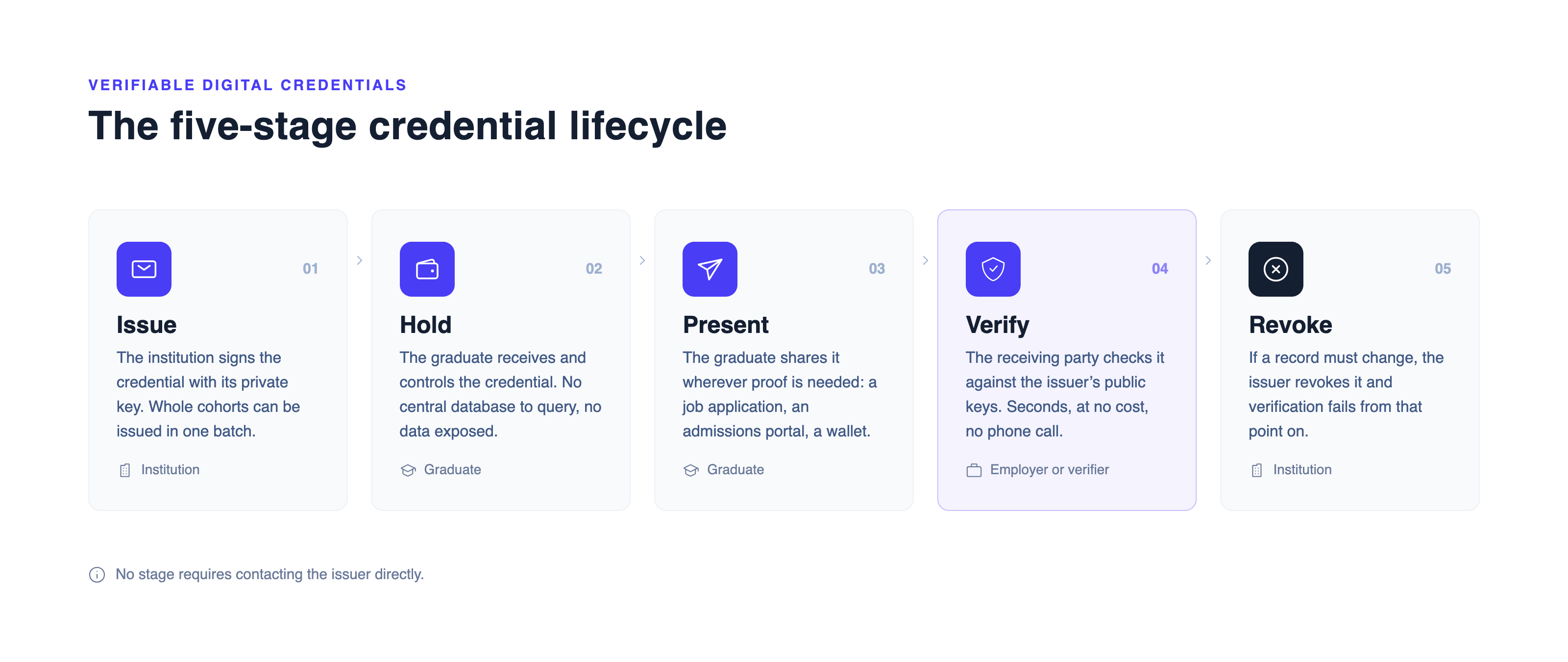
Issue. The institution signs the credential data (the award, the recipient, the date) with its private key, using an open standard format. Issuance can run in bulk, so an entire graduating cohort receives credentials in one batch.
Hold. The graduate receives the credential file or wallet entry and controls it from then on. There is no central database an employer must query, and no personal data exposed to third parties in the process.
Present. The graduate shares the credential wherever proof is needed: attached to a job application, uploaded to an admissions portal, or presented from a digital wallet.
Verify. The receiving party checks the credential against the issuer’s public keys, typically by dropping the file into a verification page. The check confirms who issued it, that the contents have not been altered, and that it has not been revoked. It completes in seconds and costs the verifier nothing. We walk through this stage in detail in How Verification Works for Verifiable Credentials.
Revoke. Records sometimes must change: an award amended, a qualification rescinded, an error corrected. The issuer can revoke a credential so that verification fails from that point on, without recalling anything from the holder.
The standards that make credentials portable
Open standards are what stop a digital credential from being locked to a single vendor. A credential issued against a published open standard can be verified by anyone who implements that standard, which means it remains valid even if the issuing platform changes or disappears.
Three families of standards matter most in education.
W3C Verifiable Credentials. The foundational data model, published by the World Wide Web Consortium and now at version 2.0. It defines how any credential, academic or otherwise, expresses its claims, its issuer and its proof.
Open Badges 3.0. The education sector’s own standard, maintained by 1EdTech. Version 3.0, approved as a final standard in June 2024, rebuilt Open Badges on the W3C Verifiable Credentials model, so a badge is now a Verifiable Credential in its own right. Institutional adoption is growing, though many platforms still issue against the older 2.0 version, so it is worth asking any provider which version they support.
TrustVC, the successor to OpenCerts and OpenAttestation. Singapore’s national framework for academic certificates was built on the open-source OpenAttestation library, with institutions issuing degree certificates and transcripts as OpenCerts files. OpenAttestation is in the process of deprecation, and TrustVC, maintained by IMDA and built on the W3C Verifiable Credentials Data Model 2.0, is now the national standard.
Whichever vendor you speak to, ask which published standards your credentials will be issued against and what happens to those credentials if you leave the platform. If the answer is a proprietary format, the credential’s lifespan is tied to the vendor’s.
What each stakeholder gains
Verifiable Credentials pay off differently for each party: registrars cut verification workload and issue at scale, graduates own records they can share instantly, and employers confirm qualifications in seconds at no cost.
For registrars and academic services. Verification requests that once consumed staff hours resolve themselves, because anyone holding the credential can check it directly. Issuance runs in batches rather than one certificate at a time, and corrections are handled through revocation and reissue rather than recalling paper. The registrar’s office stops being the permanent call centre for every qualification it has ever awarded.
For students and alumni. The credential belongs to the graduate. It cannot be lost in the way paper is lost, it can be shared as many times as needed without fees, and it works across borders without waiting on office hours in another time zone. For alumni of institutions that have closed or merged, a standards-based credential remains verifiable even though the issuer’s front desk no longer exists.
For employers and admissions teams. A check that used to take days and sometimes a fee now takes seconds and costs nothing. That changes behaviour: when verification is free, you verify everything, and the gap that fraudulent qualifications slip through closes.
Digital credentials in Southeast Asia: the SUSS example
Southeast Asia is one of the most advanced regions for digital academic credentials, and Singapore is the clearest national example: institutions across the country issue certificates and transcripts as Verifiable Credentials under the national framework, while the SkillsFuture programme drives demand for credentials on the learner side.
The Singapore University of Social Sciences (SUSS) shows what this looks like in practice: graduates receive verifiable e-certificates and e-transcripts they can share directly, and an employer confirms authenticity in seconds by dropping the file into a verification page, with no call to the registrar.
The pattern generalises beyond Singapore. National skills frameworks across the region are formalising short-form and on-the-job learning into credentials that employers can trust, and the institutions issuing them need infrastructure that handles volume, supports open standards, and works for verifiers who have never heard of the issuing body.
Recognition across borders
International students carry their qualifications into systems that have no fast way to check them, and the recognition process for a foreign qualification still routinely takes weeks. Verifiable Credentials shorten that to the length of a cryptographic check, because the receiving institution verifies the credential directly rather than corresponding with an issuer abroad.
Standards do the heavy lifting here: a credential issued against W3C Verifiable Credentials or Open Badges 3.0 in one country is verifiable by the same method in any other. The remaining work is regulatory and institutional rather than technical, and it is moving.
Getting started
Adopting digital credentials is a smaller project than most institutions expect, because the sensible first step is narrow: one credential type, one cohort, one issuance cycle.
Three things determine readiness. First, clean source data, since the credential can only be as accurate as the student records behind it. Second, a decision on standards, using the questions in the standards section above. Third, a pilot scope that produces a real result quickly: a single graduating cohort’s certificates, or one popular short course’s micro-credentials.
A pilot with one cohort teaches you more than a year of vendor evaluations, and it gives your registrar, your graduates and their employers a working example to react to. It is also the honest way to find out whether digital credentials solve a problem you actually have; not every organisation needs them on day one, and the pilot will tell you.
Frequently asked questions
What is the difference between a digital certificate and a digital credential?
In everyday use the terms overlap. Strictly, “digital credential” is the broader category: any verifiable digital record of learning, including certificates, transcripts, micro-credentials and badges. A digital certificate is one type of digital credential. Note that “digital certificate” also has a separate technical meaning in cryptography (the certificates behind HTTPS), which is unrelated to academic credentials.
Will employers and other institutions accept a digital credential?
Acceptance is what matters in practice, and it spreads because verifying costs nothing and takes seconds. In Singapore, employers already verify graduates’ digital certificates as a routine step. Where a verifier still expects a traditional document, the credential can be rendered and printed, so graduates are never worse off than with paper alone.
What happens if a credential contains an error or must be withdrawn?
The issuer revokes it. From that moment, verification of the old credential fails, and the institution issues a corrected replacement if appropriate. Nothing needs to be recalled from the holder.
Do students need special software to hold or share their credentials?
No. A credential file can be stored anywhere and shared like any attachment; verification happens on the verifier’s side through a web page. Digital wallets add convenience for holding and presenting credentials but are not required.
What does it cost an employer to verify a credential?
Nothing, for standard checks. Verification runs against the issuer’s published keys through a public verification page, with no per-check fees, which is one of the main reasons verification rates rise once institutions switch. For organisations verifying at scale, Accredify offers an enterprise verification service, a paid offering that automates complex verification processes involving large volumes, multiple document types, and consolidation of the verified data.