

If you work in a university registry, a training academy, or a ministry of education anywhere in Southeast Asia, you have probably fielded the same question more often each year: what exactly is a micro-credential, and should we be issuing them? The term now covers everything from a two-hour online module to a graduate certificate that stacks into a master’s degree, which makes it harder to answer than it should be. This guide sets out a working definition, the main types, how recognition works in the region, and what it takes for a micro-credential to be trusted by the employers and institutions who receive it.
What is a micro-credential?
A micro-credential is a certified record of a small, focused unit of learning. It verifies what the holder knows or can do, is assessed against defined standards, and is awarded by a trusted provider, usually as a digital certificate or badge.
There is no single global definition, but the most widely referenced one comes from UNESCO’s Towards a Common Definition of Micro-credentials: a micro-credential is a record of focused learning achievement, verifying what the learner knows, understands or can do, assessed against clearly defined standards and awarded by a trusted provider.
Three parts of that definition do the real work. Focused separates micro-credentials from degrees: they certify a specific competency, such as data visualisation or workplace safety auditing, rather than a broad field of study. Assessed separates them from certificates of attendance: showing up is not enough, the learner has to demonstrate the skill. And trusted provider points to the question that decides whether a micro-credential has any value at all, which we return to below.
How micro-credentials differ from traditional qualifications
Micro-credentials are shorter, narrower, and faster to earn than degrees or diplomas. They complement rather than replace traditional qualifications, and many are designed to stack into them.
A degree certifies years of study across a discipline. A micro-credential certifies weeks or months of study in one skill. That difference in scope changes how each is used: degrees signal foundational education at the start of a career, while micro-credentials record the continuous upskilling that happens across it.
The two are increasingly designed to work together. Stackable pathways let learners accumulate micro-credentials that count as credit towards a larger qualification. NTU’s stackable certificates, for example, let working adults build towards a graduate qualification one module at a time, and Malaysia’s APEL.M route (more on this below) formalises the same idea at national level.
Types of micro-credentials
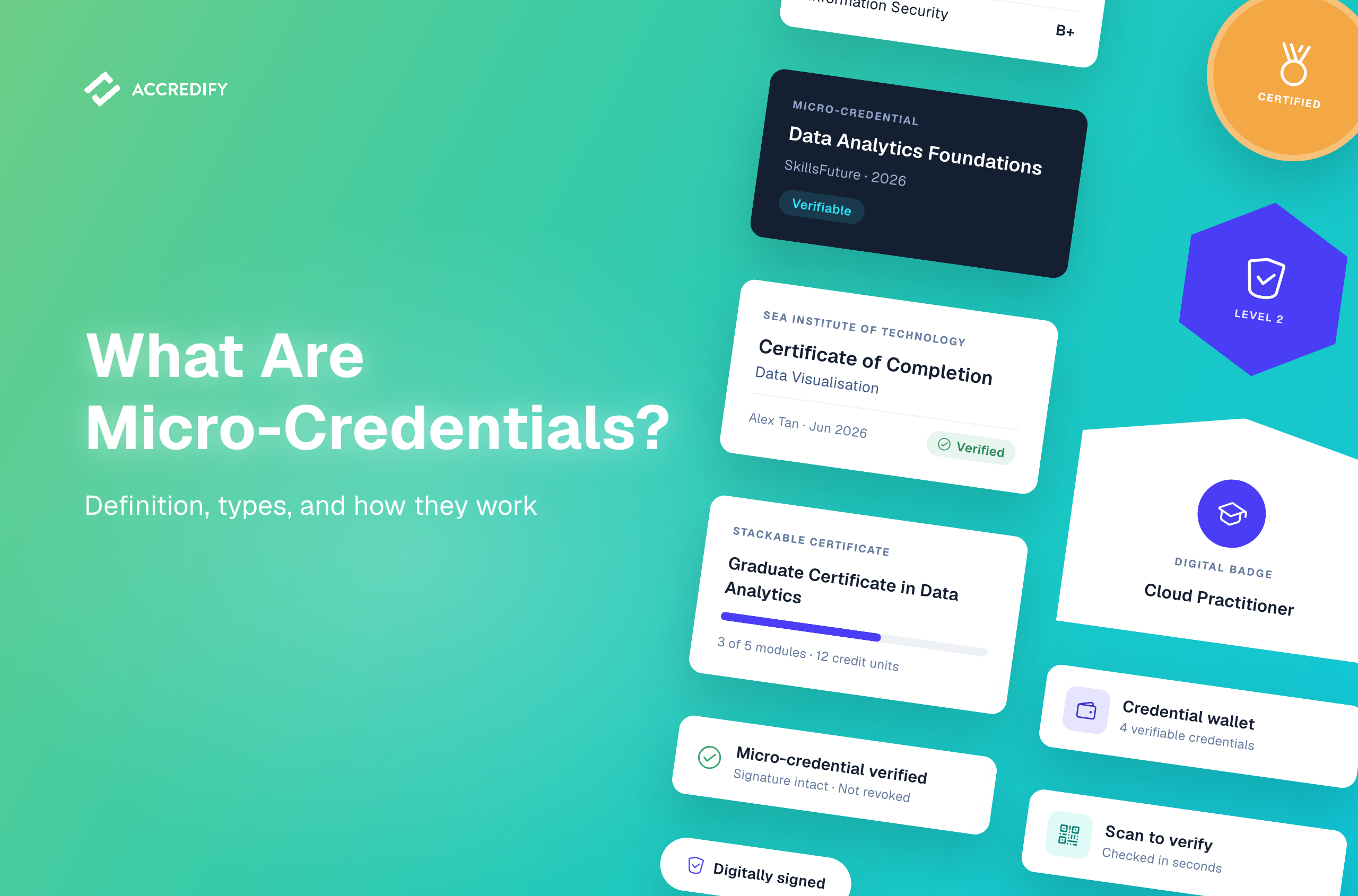
Micro-credentials commonly take the form of digital certificates, digital badges, stackable certificates that carry academic credit, and industry or vendor certifications.
The label covers several formats:
Digital certificates are the most common format in Southeast Asian higher education: a credential document issued electronically for completing an assessed short course or professional programme.
Digital badges are compact, portable credentials that follow the OpenBadges standard, with the learning outcomes and issuer embedded in the badge itself. Badges and certificates overlap but are not interchangeable.
Stackable certificates carry credit towards a larger qualification, which makes governance and record-keeping closer to that of a formal academic programme.
Industry and vendor certifications, from cloud computing credentials to project management qualifications, are micro-credentials in everything but name and often carry more weight with employers than academic short courses in the same field.
Why micro-credentials are growing so fast in Southeast Asia
National skills policies, formal recognition frameworks, and regional harmonisation efforts have made Southeast Asia one of the most active micro-credential regions in the world.
The growth is policy-led, and three layers of policy explain most of it.
Singapore built lifelong learning into national policy through SkillsFuture, which funds citizens to take short, skills-based courses throughout their careers. The institutes of higher learning responded by modularising: NTU, SMU Academy and others now run extensive portfolios of subsidised short programmes and stackable certificates aimed at working adults.
Malaysia was one of the first countries in the world to regulate micro-credentials. The Malaysian Qualifications Agency published its Guidelines to Good Practices: Micro-credentials in 2020, added quality verification for stand-alone micro-credentials in 2023, and created the APEL.M pathway, which lets learners combine accredited micro-credentials into a formal qualification. For institutions elsewhere in the region wondering what national-level governance looks like, Malaysia is the reference case.
Regionally, the ASEAN Qualifications Reference Framework (AQRF) gives member states a common yardstick for comparing qualifications, and work is under way to extend recognition to digital and micro-credentials, including the MICROCASA project’s 2024 action plan for regional micro-credential adoption. Cross-border recognition matters more in Southeast Asia than almost anywhere else, given the scale of student and worker mobility within the region.
Do employers actually value micro-credentials?
Survey evidence says yes. In Coursera’s 2025 global employer research, the large majority of employers said micro-credentials strengthen a candidate’s application, and most reported hiring at least one candidate holding one in the past year.
Coursera’s 2025 Micro-Credentials Impact Report found that 96% of employers surveyed believe micro-credentials strengthen a job application, around 90% are willing to offer higher starting salaries to candidates who hold relevant ones, and 87% had hired at least one candidate with a micro-credential in the previous year.
Two caveats keep this honest. First, employer surveys measure stated preference, not hiring behaviour at scale. Second, recognition is uneven: a credential from a known university or a major industry certifier carries weight, while an unassessed certificate from an unknown provider carries very little. That unevenness leads to the question that determines whether the whole model works.
The trust problem: a credential is only worth what a verifier can check
Because micro-credentials are numerous, short, and issued by many providers, they are easier to fake and harder to check than degrees. Verifiable digital credentials solve this by making each credential cryptographically checkable in seconds.
A registrar receiving a degree transcript has established channels to verify it. A hiring manager receiving a CV listing eight micro-credentials from five providers has none. Checking each one manually means emailing issuers and waiting days for replies, so in practice most are never checked at all. Fraudsters know this: a PDF certificate for a short course is trivial to forge, and the sheer volume of small credentials makes forgery hard to police. Generative AI makes fraud even easier than ever—a single prompt and a fake credential is ready for use.
This is why the shift to Verifiable Credentials matters for micro-credentials specifically. When a micro-credential is issued as a Verifiable Credential, it carries a cryptographic signature from the issuing institution. Anyone who receives it, whether an employer in Kuala Lumpur or an admissions office in Manila, can confirm in seconds that it was issued by the claimed institution, has not been altered, and has not been revoked, without emailing the issuer or judging whether a PDF looks legitimate.
For issuing institutions, the same infrastructure cuts the administrative load of answering verification requests and protects the institution’s brand from forged certificates circulating in its name. Educational institutions such as SMU Academy already issue digital credentials this way for their professional courses.
Getting started as an issuing institution
If your institution is launching micro-credentials, three decisions matter more than the rest: define the assessment standard each credential certifies (recognition follows rigour), decide early whether credentials will stack into formal qualifications (retrofitting credit recognition is far harder than designing for it), and issue in a verifiable format from day one, because a micro-credential that employers cannot trust will not deliver the outcomes that justify the programme.
Accredify works with universities, academies, and government bodies across Southeast Asia and the Middle East to issue verifiable digital credentials built on open standards. If you are planning a micro-credential programme, talk to our team about a pilot.
Frequently asked questions
Are micro-credentials recognised by employers?
Increasingly, yes. In Coursera’s 2025 employer research, 96% of employers said micro-credentials strengthen a candidate’s application. Recognition depends heavily on the issuer’s reputation and whether the credential was assessed.
Are micro-credentials the same as digital badges?
No. A digital badge is one format a micro-credential can take. Micro-credentials can also be issued as digital certificates or stackable academic certificates.
Do micro-credentials carry academic credit?
Some do. Stackable micro-credentials are designed to count towards larger qualifications, and frameworks such as Malaysia’s APEL.M formally recognise accumulated micro-credentials for credit. Stand-alone micro-credentials typically do not carry credit.
How long does it take to earn a micro-credential?
Anywhere from a few hours to a few months. Most sit between a single short course and a full academic term, far shorter than a diploma or degree.
Can a micro-credential be faked?
A static PDF or paper certificate can be forged easily. Micro-credentials issued as Verifiable Credentials carry a cryptographic signature that proves who issued them and that they have not been altered, which makes forgery detectable in seconds.