

What are Verifiable Credentials?
Verifiable Credentials (VCs) are digital versions of documents like degrees, licences, and identity records that can be instantly checked for authenticity. Anyone receiving a VC can confirm who issued it, that it hasn’t been altered, and that it belongs to the person presenting it — all without contacting the original issuer.
Think of the documents that prove important things about you: your university degree, your professional licence, your employment history, your vaccination record. Today, most of these exist as paper certificates or PDF files. Both are easy to copy, easy to edit, and hard to verify.
A Verifiable Credential carries the same information as its paper or PDF equivalent, but with a cryptographic seal from the issuer built in. That seal makes forgery detectable and verification instant.
Verifiable Credentials are defined by international standards, including one from the World Wide Web Consortium (W3C), the same body that maintains the core standards behind the internet itself. This means Verifiable Credentials work across borders, systems, and vendors rather than being locked to any single company’s technology.
Why do Verifiable Credentials exist?
Verifiable Credentials exist because the way we currently prove things about ourselves is slow, unreliable, and unscalable.
Consider what happens when an employer wants to confirm a candidate’s degree. They might email the university and wait days for a reply. They might pay a background-check firm to do the same thing. Or, most commonly, they simply look at the PDF the candidate sent and take it at face value.
Each of these options has a problem. Manual verification is slow and expensive. Taking documents at face value exposes the company to fraud; diploma mills and doctored certificates are a well-documented, global industry. And verification often depends on the issuer still existing and responding: if a training provider shutters, every certificate it ever issued becomes effectively unverifiable.
AI has made the problem urgent
For decades, forging a convincing document took some effort. Generative AI has removed that barrier. Realistic fake degrees, doctored transcripts, and fabricated employment letters can now be produced in minutes by anyone, at no cost, and at a quality that routinely passes visual inspection. The traditional signals people relied on to spot fakes, such as fonts, seals, letterheads, and signatures, can all be replicated convincingly by AI.
At the same time, AI is accelerating the volume of claims that need checking. Organisations are using AI to screen thousands of job applications, process licence submissions, and onboard customers at a scale where manually verifying every document was never realistic to begin with.
This creates a widening gap: it has never been easier to produce a fake document, and never been more impractical to verify a real one by hand. Verifiable Credentials close that gap by making authenticity something a machine can check in seconds, rather than something a human has to judge by eye.
How do Verifiable Credentials work?
Verifiable Credentials work through three roles: an issuer who creates and signs the credential, a holder who stores and presents it, and a verifier who checks it. The system is often called the “trust triangle.”
A useful analogy is a passport. Your government (the issuer) creates it with security features built in. You (the holder) carry it and present it when needed. A border officer (the verifier) checks those security features without needing to phone your government. Verifiable Credentials apply the same model to any document, with cryptography playing the role of the security features.
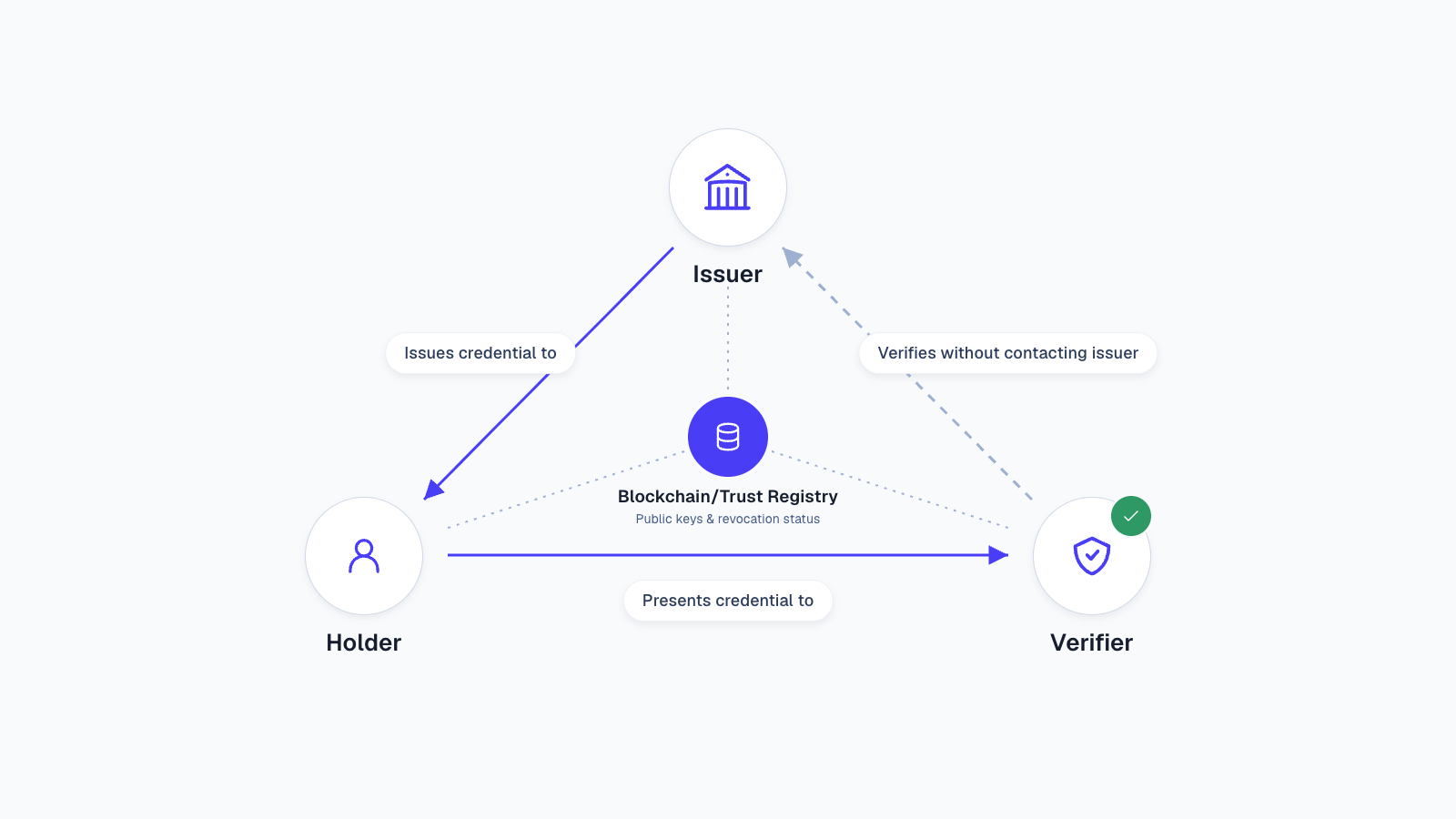
The three roles
- 1The issuer is the organisation that makes a claim: a university stating you earned a degree, a regulator stating you hold a licence, an employer stating you worked there.
- 2The holder is the person or organisation the VC is about, and keeps it in a digital wallet or document store they control.
- 3The verifier is whoever needs to check the claim: an employer, a government agency, a bank, another institution.
What happens when a VC is issued
The issuer creates the credential as structured digital data containing the claims (for example, name, qualification, and date awarded) and signs it with their private cryptographic key. This signature is mathematically bound to the exact contents of the credential. Change a single character, and the signature no longer matches. The signed credential is then given to the holder.
What happens when a credential is verified
When the holder presents the credential, the verifier’s software performs a series of automated checks using the issuer’s public key, which is openly published. The whole process takes seconds and requires no phone calls, emails, or third-party checking services. Crucially, the issuer doesn’t need to be involved (or even still exist) at the moment of verification.
What makes a credential “verifiable”?
Four checks separate a verifiable credential from an ordinary digital document:
- 1Authenticity — was it really issued by who it claims? The cryptographic signature can only have been produced by the issuer’s private key, so a verifier can confirm the source with certainty.
- 2Integrity — has it been altered? Because the signature is bound to the exact contents, any tampering, however small, causes verification to fail.
- 3Validity — is it still in force? Issuers can revoke credentials (for example, a licence that has been suspended) or set expiry dates, and verifiers can check this status in real time.
- 4Ownership — does it belong to the person presenting it? Credentials are bound to their holder, so a stolen or borrowed credential fails verification.
A PDF certificate, even a well-designed one, offers none of these guarantees. It can be edited, it carries no reliable link to its issuer, there’s no way to know if it’s been revoked, and nothing ties it to the person who emailed it to you.
| Paper certificate | PDF / scanned copy | QR code to a webpage | Verifiable Credential | |
|---|---|---|---|---|
| Can it be forged or edited? | Yes, easily with AI. | Yes, easily with AI. | Yes; QR redirects can also lead to spoof webpages. | No. Any change returns an unverified result. |
| How is it verified? | Manual inspection, contacting issuer. | Contacting issuer, or not at all. | Visiting the linked page. | Automatic cryptographic check, in seconds. |
| Works if the issuer disappears? | No | No | No | Yes |
| Reveals only what’s needed? | No; shows everything. | No; shows everything. | Depends on implementation. | Yes; supports selective disclosure. |
| Machine-readable? | No | Partially; 15–30% OCR failure rate. | Partially | Yes, fully |
One row deserves a note: selective disclosure. Verifiable Credentials can be designed so the holder shares only the specific facts a verifier needs — proving you’re over 18 without revealing your date of birth, or proving you hold a qualification without exposing your grades. Paper and PDFs are all-or-nothing.
What are Verifiable Credentials used for?
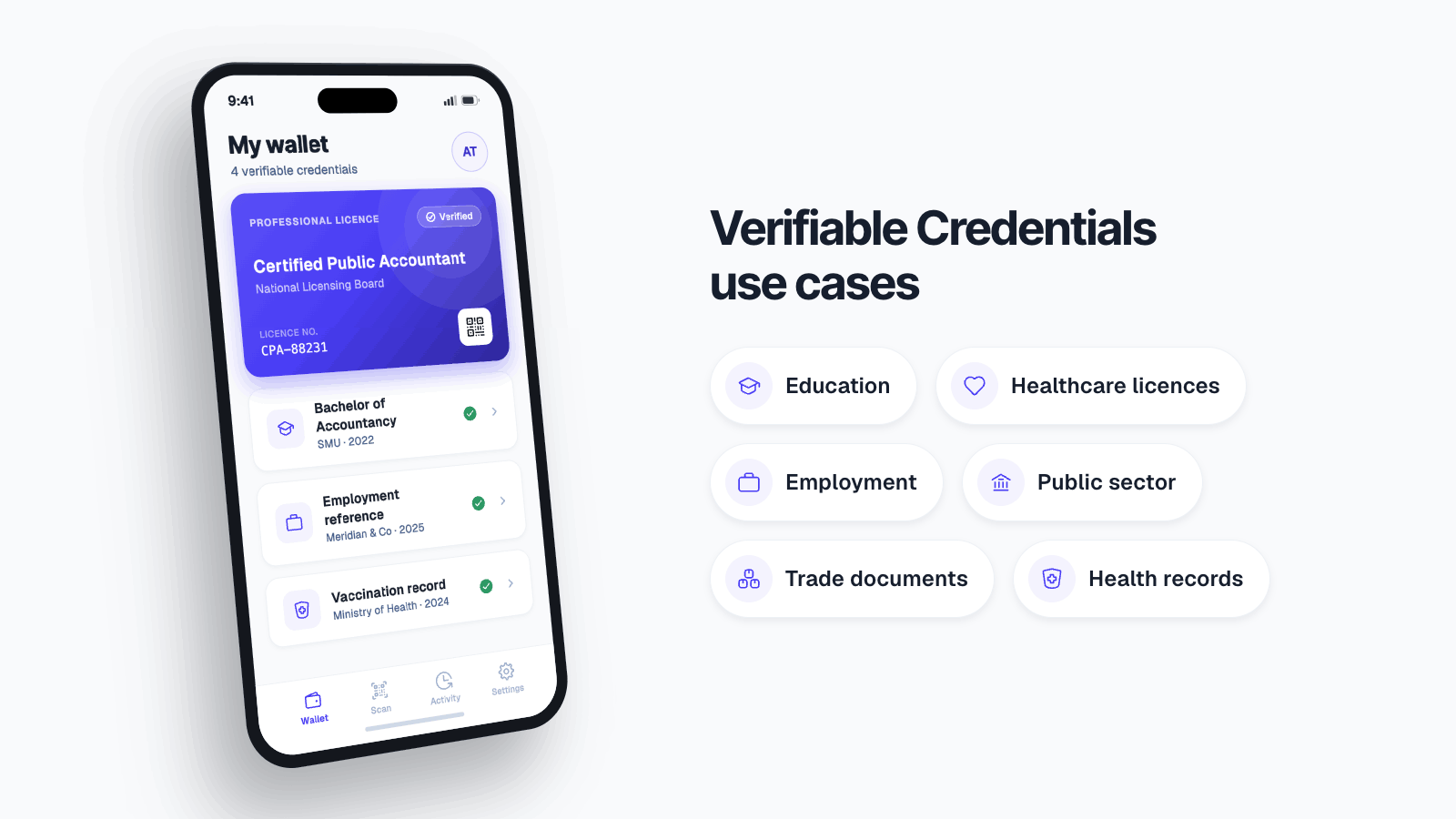
Because Verifiable Credentials are a general-purpose standard, they apply anywhere that one party needs to trust a claim made by another. Common use cases include:
- Education records. Universities and training providers issue degrees, transcripts, and course certificates that graduates can share with anyone and on any social platform (like LinkedIn), and employers can verify instantly — ending the wait for manual confirmation.
- Professional licences. Regulators issue licences to doctors, engineers, lawyers, and other professionals, with real-time revocation checking so a suspended licence fails verification immediately.
- Employment history. Employers issue verifiable records of roles and tenure, letting candidates prove their experience without background-check delays.
- Health records. Vaccination records, test results, and fitness-to-work certificates can be verified across borders, as many countries demonstrated with digital health certificates during the COVID-19 pandemic.
- Government-issued documents. Digital identity documents, residency permits, and business registrations can be issued as credentials that other agencies and private-sector verifiers can trust without database lookups.
- Trade and business documents. Certificates of origin, authenticity documentation, compliance attestations, and audit reports can move between companies and customs authorities with their authenticity intact.
Are Verifiable Credentials the same as blockchain or digital IDs?
Verifiable Credentials are related to blockchain and digital identity, but the terms are not interchangeable. This is worth untangling, because the confusion is common.
Verifiable Credentials vs. blockchain. Verifiable Credentials do not require a blockchain. The W3C standard is technology-neutral: the cryptographic signatures that make credentials verifiable work independently of any ledger. Some implementations use a blockchain to publish issuer keys or revocation lists, but many use ordinary web infrastructure instead. A credential’s trustworthiness comes from the issuer’s signature, not from being “on a blockchain.”
Verifiable Credentials vs. digital identity. Digital identity is the broader concept of representing who you are online. Verifiable Credentials are one building block within it: the part that lets trusted organisations make signed, checkable claims about you. A related standard, decentralised identifiers (DIDs), provides the addressing layer that credentials can be anchored to, but you can understand and use Verifiable Credentials without ever touching a DID.
Verifiable Credentials vs. NFTs. Both are sometimes described as “digital certificates,” which invites the comparison, but they solve different problems. NFTs prove ownership of a digital token and are typically public and tradeable. Verifiable Credentials prove claims about a person or organisation, are private by default, and are bound to their holder precisely so they cannot be traded or transferred.
Key takeaways
Verifiable Credentials are tamper-proof digital documents built on international VC standards, such as the open W3C standard, and verifiable by anyone in seconds without contacting the issuer. Every credential answers four questions automatically: who issued it, has it been altered, is it still valid, and does it belong to the presenter. As AI makes convincing document fraud effortless and pushes verification volumes beyond what manual checking can handle, cryptographic verifiability is becoming the practical baseline for trusting documents at all. For organisations that issue or check credentials of any kind, the question is shifting from whether to adopt Verifiable Credentials to when.
Frequently asked questions
Can a Verifiable Credential be revoked?
Yes. Issuers can revoke credentials at any time, and verifiers check revocation status as part of verification. A revoked credential fails the check immediately, which matters for things like suspended licences or withdrawn qualifications.
Do Verifiable Credentials expire?
They can, if the issuer sets an expiry date. This suits documents with natural validity periods, such as certifications requiring renewal. Credentials without an expiry date remain verifiable indefinitely, even if the issuer later ceases to exist.
What standard are Verifiable Credentials based on?
Most VCs are based on the W3C Verifiable Credentials Data Model, an open international standard first published in 2019 and since updated. Because it’s an open standard rather than proprietary technology, credentials issued by one compliant system can be verified by any other.
However, many other VC standards are emerging, such as Singapore’s TrustVC, OID4VC, and ISO 18013-5.
Does the holder need a special app or wallet?
It depends on the implementation. Some systems use dedicated digital wallet apps; others deliver credentials as files or links that work in an ordinary browser. The standard itself doesn’t mandate a particular storage method.
Are Verifiable Credentials legally recognised?
Recognition is growing and varies by jurisdiction. The EU’s eIDAS 2.0 regulation, for instance, establishes a legal framework for digital credentials across member states, and several governments in Asia and elsewhere have adopted Verifiable Credentials for official documents, such as Singapore’s ACRA. As with electronic signatures a decade ago, legal frameworks are steadily catching up to the technology.
Can Verifiable Credentials be verified offline?
In many implementations, yes. Because verification relies on checking a cryptographic signature rather than querying a live database, the core checks can work without contacting the issuer, though real-time revocation checking may require a connection.