

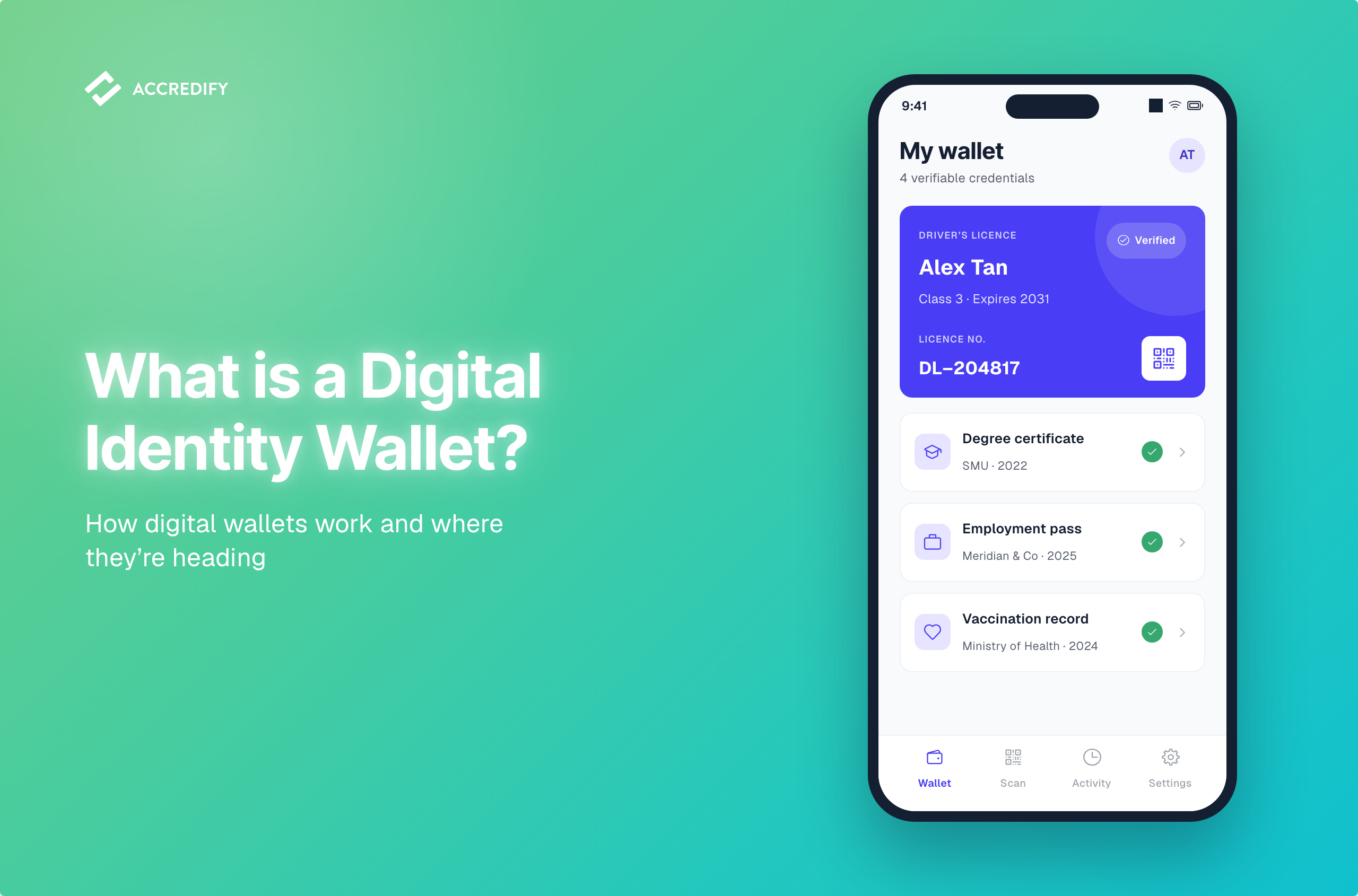
Proving who you are and what you hold still involves a surprising amount of paperwork. Certified copies for a university application, notarised documents for an overseas bank account, the same scanned certificates uploaded to portal after portal. A digital identity wallet replaces that routine with something closer to tapping a card: an app that holds your verified information and presents it in seconds, in a form the other side can trust.
Wallets are also about to become far more common. Every EU member state must offer one to its citizens by 24 December 2026 under the eIDAS 2.0 regulation, and Singapore residents have carried one for years without necessarily calling it that.
The short answer
A digital identity wallet is an app on your phone or in your browser that stores Verifiable Credentials, digital documents cryptographically signed by whoever issued them, and lets you present them to others, who can confirm they are genuine in seconds without contacting the issuer.
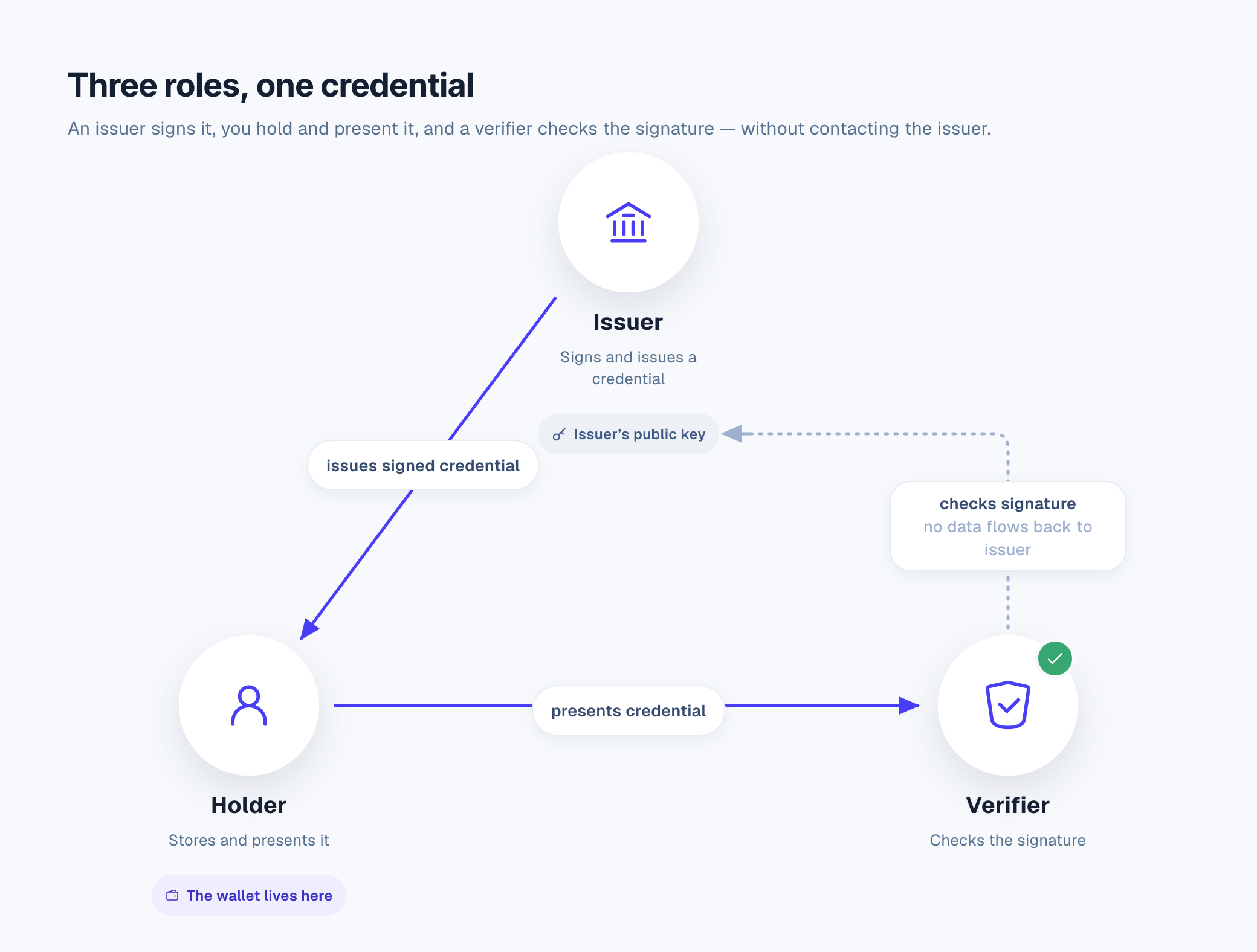
In the standard model of digital identity, three parties interact: an issuer signs a credential, a holder keeps and presents it, and a verifier checks it. The wallet is the holder’s tool. It is where your credentials live, and the control panel for deciding who sees what.
What goes in one
A digital identity wallet can hold any credential issued in a verifiable format: identity documents, qualifications, licences, memberships, and records such as vaccination certificates.
In practice, the contents depend on what issuers in your country have digitised. Singapore’s Singpass holds national ID details alongside driving licences and other government records. The EU’s wallet will carry national ID, diplomas, prescriptions and more. In the United States, 21 states and Puerto Rico now issue mobile driving licences, many of which sit in Apple Wallet or Google Wallet. Education is moving the same way, with degrees and micro-credentials increasingly issued as Verifiable Credentials rather than PDFs.
How it works, without the jargon
The issuer creates a credential and signs it with a digital signature, similar to a wax seal that cannot be forged or reused. The wallet stores the credential on your device. When you present it, the verifier’s software checks the signature against the issuer’s published key. If the document has been altered in any way, the check fails.
Two details in that flow are worth pausing on.
First, your credentials are stored on your device, not on a blockchain or a central database. Some systems use a public ledger to anchor issuer keys or revocation records, but the credential itself, with your personal data in it, stays with you.
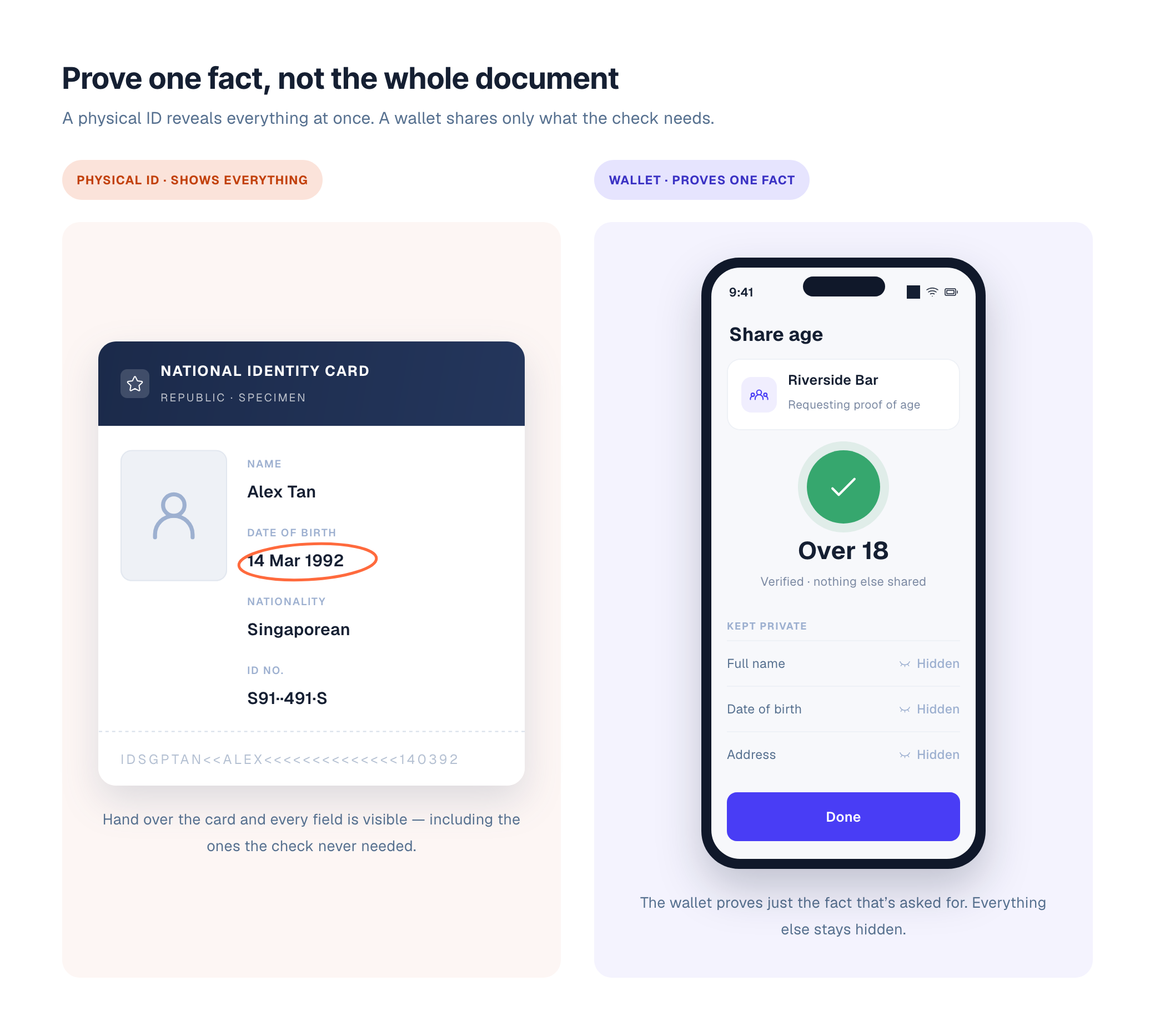
Second, you rarely need to show a whole document. Wallets support selective disclosure, which means proving a single fact without revealing the rest. The classic example is age: you can prove you are over 18 to a bar without showing your name, address or date of birth. The bouncer learns exactly one thing about you, and nothing else.
Who controls the data
With a digital identity wallet, the holder decides what is shared, with whom, and for how long. Each presentation is a deliberate act of consent rather than a copy of a document leaving your hands for good.
This is a meaningful shift from how identity works online today, where signing in usually means routing through a platform account, federated identity, and the platform sees every login. The design philosophy behind the wallet model is called self-sovereign identity: the idea that individuals, not platforms, should hold and control their own identity data. You do not need to subscribe to the ideology to benefit from the engineering.
National wallets around the world
Governments are the biggest drivers of wallet adoption, because they issue the credentials people rely on most.
Singapore remains the most mature example. Singpass is used by the overwhelming majority of residents for government and private-sector services alike, and shows what a wallet looks like once it is simply part of daily life.
The European Union has set the hardest deadline in the field: all 27 member states must offer a wallet by 24 December 2026.
The UAE has taken a similar path with UAE Pass, a single national digital identity for citizens and residents used across government and banking services.
Accredify’s wallet, Nucleus, lets recipients hold and present Verifiable Credentials from any issuer. Securely and on-demand.
Learn more about Nucleus →Where wallets are heading: from storage to services
Today’s wallets are mostly containers. They hold credentials and present them one at a time, which is useful but modest. The next step is the wallet as your access point to VC-enabled services: processes that consume verified data directly, with your consent, instead of asking you to gather and submit documents.
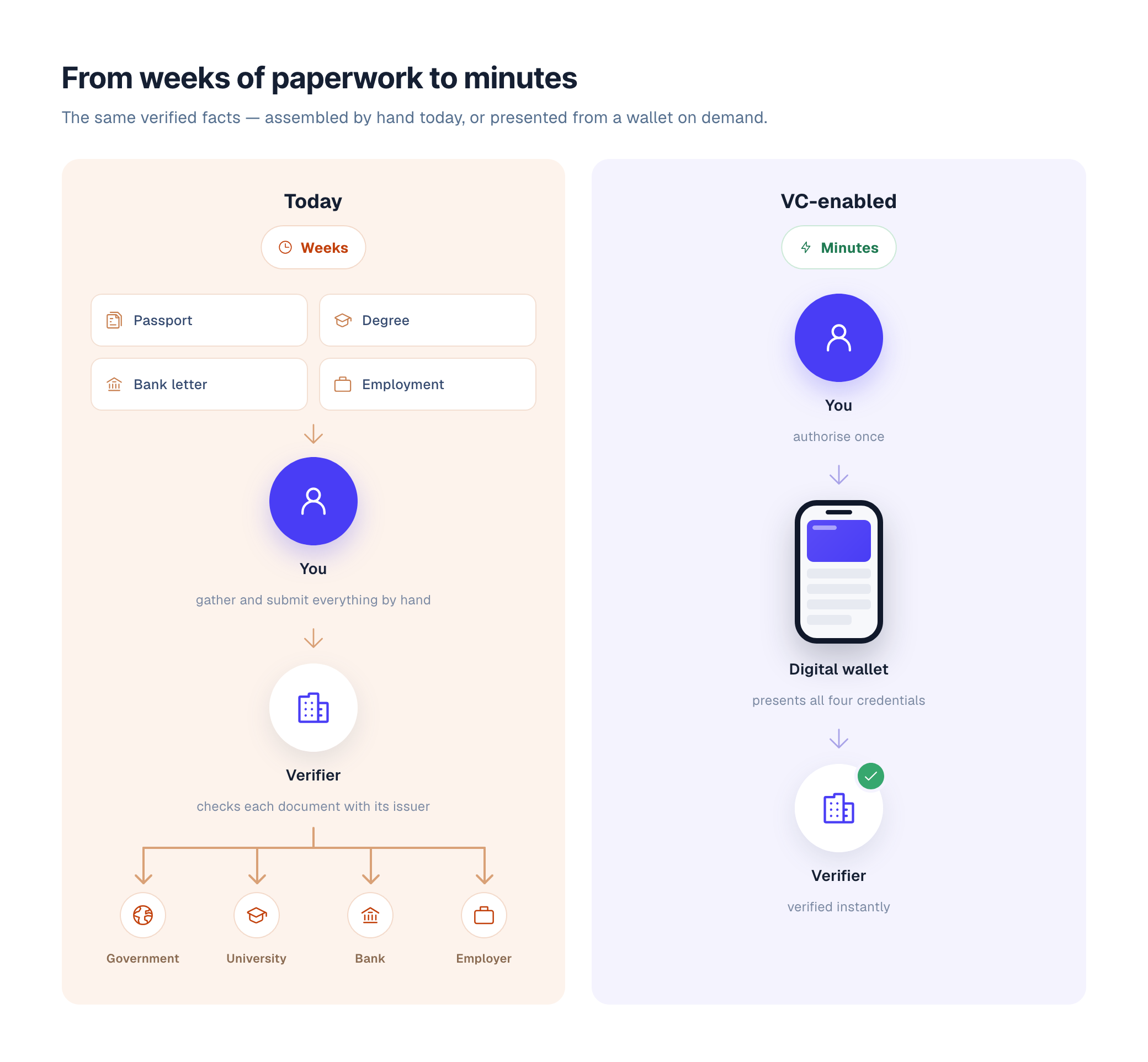
Consider a visa application. The process exists to establish verified facts about you: identity, qualifications, employment, financial standing. Today you assemble those proofs by hand, and an officer checks each one manually, which is why applications take weeks. If those facts already sit in your wallet as signed credentials, you could authorise the application once and let the wallet locate and present exactly what the process requires. The receiving side gets data it can verify in seconds, and weeks of processing compress into minutes.
Visa applications are one example. Verified membership credentials from a professional association or chamber of commerce could power consent-based networking, where you connect with people whose affiliations are proven rather than claimed. A company holding verifiable business credentials could register with an overseas corporate registry without couriering apostilled documents across borders.
None of this works without one precondition: issuers putting signed, standards-based credentials into circulation. The wallet can only assemble what has been issued. That is the honest limit of the vision today, and it is why the near-term work sits with issuing organisations.
What this means for issuing organisations
If governments are putting a wallet in every resident’s pocket, the question for institutions, agencies and associations is whether their documents can live in one. A paper certificate, or a PDF that anyone can edit, cannot.
Getting wallet-ready means issuing credentials that are digitally signed, revocable, and built on open standards such as W3C Verifiable Credentials, OpenBadges 3.0 and ISO mDL, so they work in the wallets your recipients already use rather than in a proprietary silo.
Nexus lets your organisation issue signed, revocable, standards-based Verifiable Credentials that work in the wallets your recipients already carry.
Learn more about Nexus →Frequently asked questions
Is a digital identity wallet the same as Apple Wallet or Google Wallet?
Not quite. Apple Wallet and Google Wallet are general-purpose wallets that increasingly hold identity credentials, such as mobile driving licences in some US states. A digital identity wallet is defined by what it holds and proves, and several apps, including national wallets like Singpass, serve that purpose.
Is my data stored on a blockchain?
No. Your credentials are stored on your device. Some systems use a distributed ledger to anchor issuer keys or revocation status, but your personal data does not go on-chain.
What happens if I lose my phone?
It depends on the wallet. Most national wallets tie credentials to your verified identity, so you can re-authenticate on a new device and have credentials re-issued. Wallets without an identity-backed recovery route place more responsibility on you to keep backups.
Do I need a digital identity wallet?
In the EU, member states must offer you one by the end of 2026, though using it remains voluntary. Elsewhere, it depends on what issuers and services in your country support. As more services accept Verifiable Credentials, the convenience case strengthens on its own.
What is the difference between a digital identity and a digital identity wallet?
Your digital identity is the full set of attributes and credentials that represent you online. The wallet is the tool you use to hold and present the verifiable parts of it.
Ready for the wallets your recipients already carry?
Accredify helps governments, institutions and businesses issue Verifiable Credentials that are wallet-ready from day one. If you are exploring what that would look like for your organisation, speak with us.
Book a demo →