

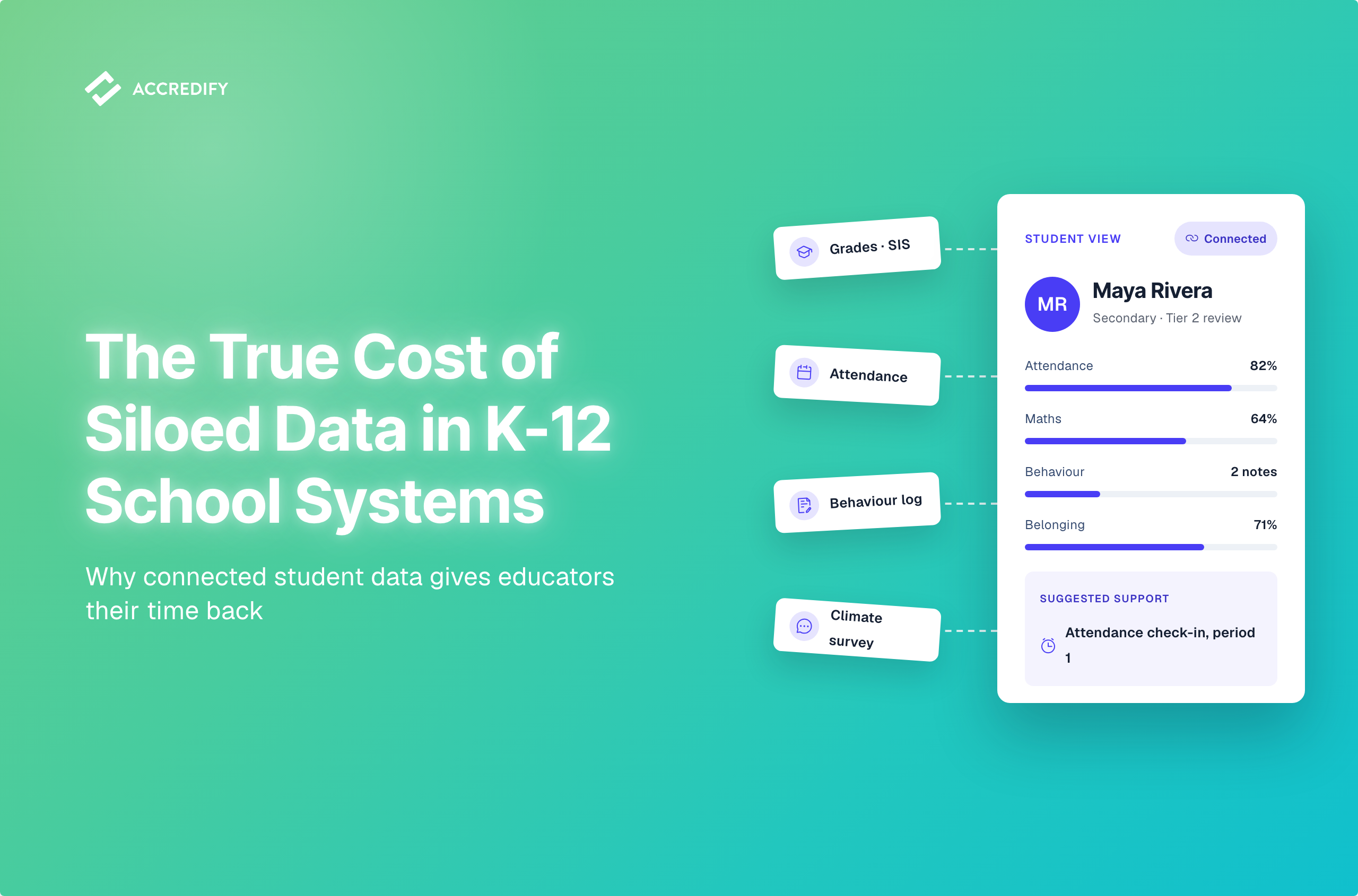
Districts today have access to more student data than ever before. But often, that information is scattered across disconnected systems, with grades in a student information system (SIS), attendance in another, behaviour notes in spreadsheets, and school climate feedback in an app or standalone document.
When your technology doesn’t communicate, the heavy lifting falls to school staff. Educators end up spending valuable time manually piecing together a student’s story, which can delay support and make it harder to see who actually needs help.
In this guide, we’ll explore the real costs of keeping data separated across your district. More importantly, we’ll look at how bringing these metrics together can help your team spend less time on data entry and more time making informed decisions that support student success.
The hidden operational costs of siloed data in K-12 school systems
When your technology systems don’t talk to each other, the hidden costs add up quickly. These disconnects can actually get in the way of your district’s strategic goals and, ultimately, student success.
Identifying and closing these gaps helps your district’s educators dedicate more time and energy to developing personalised, effective student support. Let’s review some of the hidden costs, how your district can pivot, and the payoff of resolving each issue after breaking down data silos.
Missing the whole story of each student
When you can only see pieces of a student’s performance and background, it’s difficult to understand the root cause of certain issues and provide effective support. Without bringing this data together, educators may struggle to see how academic challenges connect to other factors, like school climate or student wellbeing.
Looking at numbers in isolation means missing the bigger picture:
- 1 The cost: When academic data is disconnected from attendance, behaviour, and coursework (ABC) metrics, educators can only treat symptoms instead of root causes. For example, a team might give a student a Tier 2 maths intervention when the real issue isn’t maths itself — it’s that maths is first lesson, and this student is often late for school.
- 2 The pivot: Bring your core data into one connected view so you can look at the whole child before making decisions. By reviewing attendance patterns alongside maths scores, for instance, you can quickly work out whether a student needs targeted tutoring or an attendance intervention.
- 3 The payoff: You can make smarter decisions about where to invest limited resources while connecting students with the right support sooner.
Spending educator time piecing together data
Every minute educators spend digging for data is time taken away from lesson planning and connecting with students. When your systems don’t communicate, highly trained staff end up bogged down in administrative tasks.
Manually piecing together student records creates daily roadblocks for educators:
- 1 The cost: Disconnected systems lead teachers and counsellors to spend hours pulling data from different systems or spreadsheets.
- 2 The pivot: Bring student data together with a Multi-Tiered System of Supports (MTSS) platform that securely connects information from across your district in one place, reducing the need for double data entry.
- 3 The payoff: Educators get their valuable planning time back. Instead of spending team meetings gathering data, your MTSS teams can use that time to plan specific next actions and interventions.
Take a look at your current tools and ask your teams how many hours a week they spend preparing for MTSS meetings. Giving them even a fraction of that time back means more frequent, higher-quality check-ins with the students who need them most.
Hindering proactive college and career readiness planning
Preparing students for life after graduation means tracking their progress across academics and through career pathways over several years. When that information is scattered across different platforms, keeping students on track may require time-consuming manual audits.
Disconnected data makes post-secondary planning much harder than it needs to be:
- 1 The cost: When graduation requirements and career pathway progress are kept in separate systems, tracking readiness becomes a reactive scramble. This may leave counsellors blind to missed opportunities or credit gaps until later in students’ secondary school years.
- 2 The pivot: Bring graduation and pathway progress into one clear view. With a solution that brings together credits, course requirements, earned credentials, and pathway progress, your team can see where students stand and identify potential roadblocks earlier.
- 3 The payoff: Counsellors can provide proactive guidance. They can confidently match students to opportunities that fit their strengths early in secondary school and reduce stressful final-year surprises for families.
Treating behaviour as a standalone issue
Behavioural incidents typically don’t happen out of nowhere. They are often tied to academic frustration, a challenging school climate, or outside stressors. Looking at discipline data on its own makes it difficult for schools to determine which intervention will actually help a student get back on track.
Keeping behaviour notes in a separate system makes it much harder to support the whole child:
- 1 The cost: When behaviour logs are cut off from academic and attendance records, educators can’t see the root cause of why a student is struggling or acting out. This often forces staff to rely on reactive discipline rather than proactive, long-term support.
- 2 The pivot: Bring behaviour data into the same student support system as attendance, academics, and interventions. With a connected view of each student, teams can more easily spot patterns and determine what support may be needed.
- 3 The payoff: Educators can spot warning signs early and provide the exact help a student needs, long before behavioural challenges start to derail their progress or post-secondary plans.
By shifting away from isolated disciplinary logs, you give your teachers the context they need to understand why a student is frustrated. This approach changes the conversation from simply handing out consequences to actively helping the student stay engaged in the classroom and on track for their future.
Moving towards a connected platform
Creating lasting change in your district means moving away from scattered tools and towards a single, connected platform. Bringing together attendance, behaviour, academics, and school climate feedback doesn’t just save time and resources. It solves the daily frustrations of siloed data.
When you equip your teams with a complete picture of the student experience, your district can move from reactive responses to student needs and guide every learner towards their full potential, creating a truly student-centric experience.
The best place to start is to look closely at your current tools and identify where your staff enter or review the same data. By making connected data a priority moving forward, you build a strong foundation for supporting the whole child, ensuring your technology works just as hard as your educators do.
Accredify issues transcripts, certificates and earned credentials as Verifiable Credentials, so student achievements stay connected and trusted wherever they travel. See how it works for schools and districts.
Explore Accredify for education →