

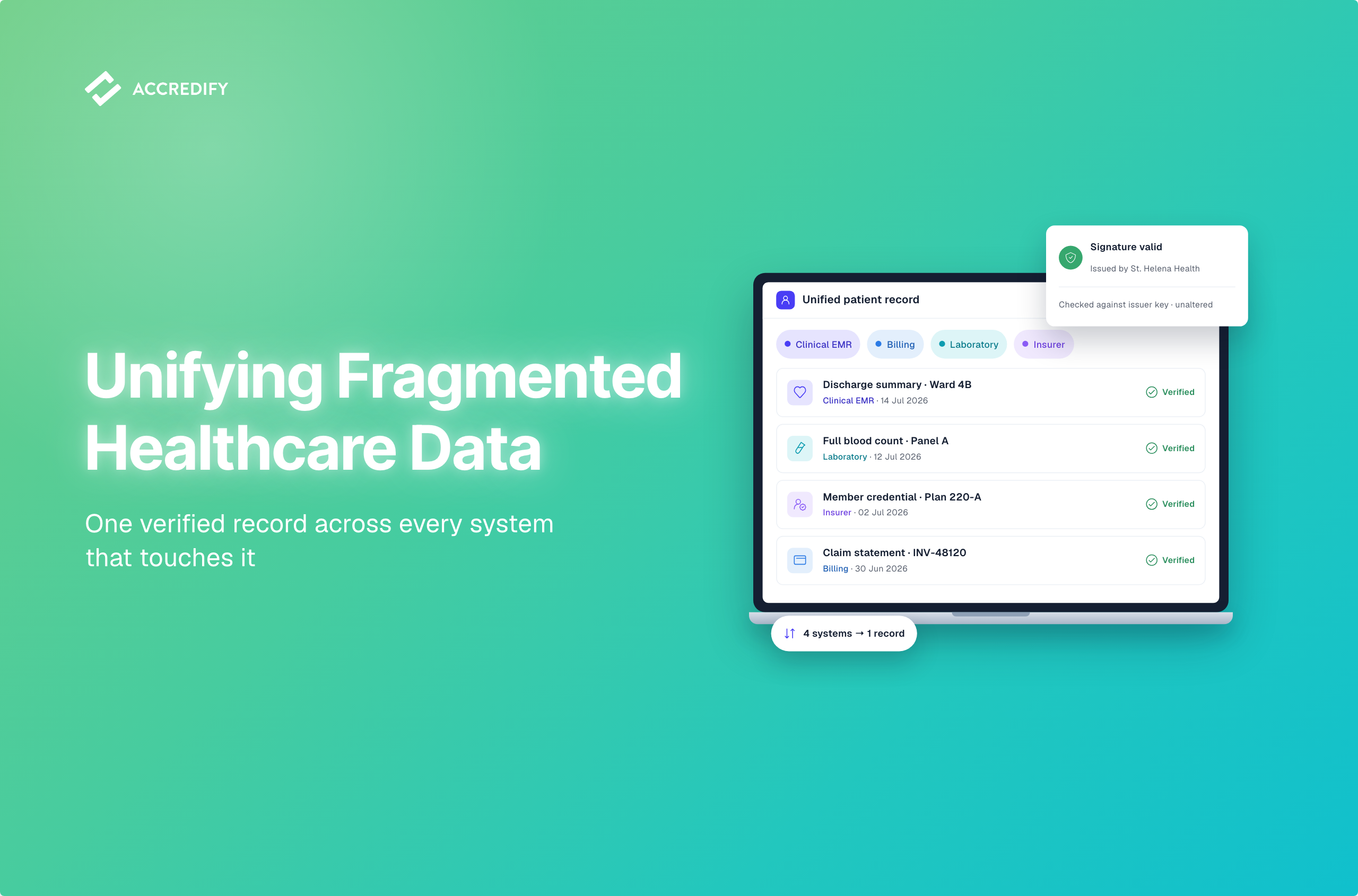
Patient care suffers when isolated databases trap medical records, billing data, and member credentials in disconnected silos. This data fragmentation in the healthcare sector forces administrative staff into endless cycles of manual verification, delaying care delivery and driving up operational costs.
Regain control over your networks by applying the following strategies to consolidate your platforms, establish verifiable trust across entities, and lay a resilient foundation for advanced health analytics.
Simplify your systems
Stop patching legacy systems with middleware that adds another layer of complexity; instead, target the immediate financial and operational bottlenecks that drain your resources. Address these core areas of friction in your software architecture:
- Bureaucratic roadblocks. Unnecessary manual workflows, such as redundant data entry, can inflate operational overhead and increase the likelihood of human error. Simplify duplicate manual workflows and consolidate record-keeping into streamlined databases to prevent erroneous data entry.
- Format and system incompatibilities. Inconsistent data types, file formats, and formatting can delay data processing across platforms. For example, if some staff members write birthdays as MM/DD/YY while others write them as DD/MM/YYYY, that can lead to errors. Ensuring your data is handled consistently minimises errors and reduces data translation time.
- Data siloing across platforms. Healthcare data is often stored across multiple platforms, leading to inconsistent or redundant data storage practices. Implementing a unified data platform standardises inputs within a single, cohesive architecture, enabling more effective data use and sharing.
Identifying administrative bottlenecks in your current data architecture helps you streamline congestion points and increase data interoperability. Targeting those areas first ensures a faster return on investment and minimises disruption to daily patient care.
Strengthen trust through secure verification
Consolidating data from multiple healthcare systems requires strong safeguards to ensure information remains secure, accurate, and trustworthy. Organisations should implement authentication, encryption, and integrity validation throughout the data exchange process.
Two foundational verification methods help establish trust:
- 1 Digital certificates and authentication. Digital certificates authenticate the identity of systems exchanging information and establish encrypted connections, helping ensure data is shared only between trusted parties.
- 2 Integrity validation. Automated validation processes, such as message validation, digital signatures, and audit logging, help confirm that data has not been altered in transit and remains complete and reliable as it moves between systems.
Together, these security controls help organisations protect sensitive health information, maintain data integrity, and support compliance with regulations such as HIPAA. A trusted data foundation strengthens confidence among providers, patients, and other stakeholders while enabling secure interoperability.
Deploy intelligent frameworks
Artificial intelligence (AI) models can assist in manual data processing and system optimisation. Before integrating AI tools into your database, assess whether your data is consolidated, accurate, and systematically organised to ensure a smooth transition to automated workflows.
Here are some key areas in which AI tools can assist in administrative work:
- Reducing data overload. AI can automate data integration across platforms by processing and consolidating vast amounts of information in a short time. To reduce the risk of unexpected outputs, ensure your dataset is accurate and systematised before implementing automated workflows.
- Targeting bottleneck areas. Automation can ease administrative overload in key areas. Consider automating your patient scheduling procedures or manual data entry processes to streamline patient care services and administrative tasks.
- Deploying predictive analytics. AI can help synchronise and translate data into care plans that support improved patient outcomes. Rather than responding reactively to a health event, you can use predictive analytics to anticipate risk and allocate resources to effectively manage outcomes.
Incorporating automated solutions into key workflows eases administrative burden and creates an integrated data framework. While AI can dramatically reduce data processing times, it is important to minimise data verification errors and hallucinations.
Using a connected healthcare platform
Utilising interoperable, portable data across your healthcare network can transform disorganised records into actionable clinical intelligence. Construct a unified architecture to drive immediate value across your healthcare operations, reducing administrative burnout and improving patient outcomes.
In healthcare networks, data portability and ease of use are key drivers of efficient operations. When providers can seamlessly access the verified health data of the patients they care for, they can focus on delivering quality care without the burden of paperwork.
A successful healthcare database solution should actively bridge the gap between accessible analytics and secure data exchanges to provide effective support to larger healthcare networks. Building a unified data system, supported by automated workflows and authentication checkpoints, ensures the smooth and secure transfer of data between in-network healthcare providers while supporting patients with actionable treatment plans.
Accredify issues health records and credentials as Verifiable Credentials, so data moving between providers can be authenticated the moment it arrives. See how it works for healthcare networks.
Explore Accredify for healthcare →